
Variant rules
While playing, various variants emerged.
Here are the first ones:
1. peoc’h is the silent variant: playing without saying a word!
Players do not announce their calculations out loud. The basic rules of Kavet m’eus still apply, but after each trick, it is the next player’s turn.
If a player cannot follow, he may ask the player who is currently collecting their trick to explain the operation out loud.
If the operation is correct, the player who could not follow must skip a turn.
If the operation is actually incorrect, the player must give all the cards they wrongly tried to collect to the challenger and skip a turn.
2. Pari
In this variant, the “event” cards are removed at the beginning of the game. Players try, using the results of their calculations, to reach numbers that are predefined in a table. Each player prints or draws their own table. A downloadable version is available here.
The more players there are, the fewer numbers are used. For three players, six numbers seem appropriate.
These numbers are determined quickly: they correspond to the first six cards drawn from a well-shuffled deck. Any duplicate is ignored and returned to the deck. The six different values are written in the first column of the table.
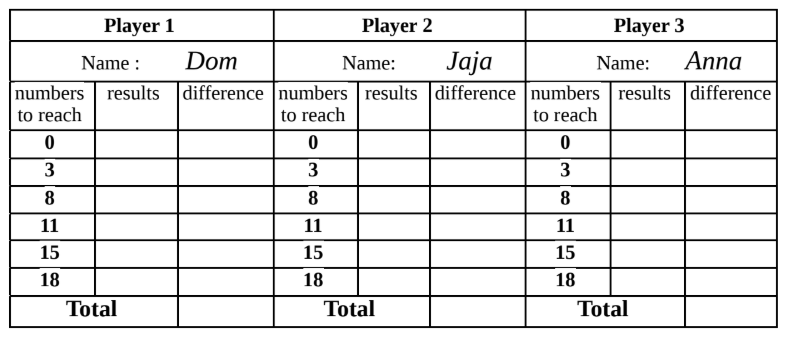
The cards used to determine the numbers are then returned to the deck.
The basic rules of Kavet ’m eus apply throughout the game. There are always at least three cards face up on the table, but this time two cards are enough for a calculation whose result matches one of the predefined numbers.
When a player successfully completes a calculation, he sets aside the cards used, and the next player takes their turn.
Each player must immediately enter the result of their calculation in the table in order to get as close as possible to one of the predefined numbers, even if this results in a larger difference. This difference is also entered in the table.
It is not possible to correct a result once it has been entered, even if the exact target could be reached later.
The two variables X will surely add some fun for the players :)
Example of the end of a game:
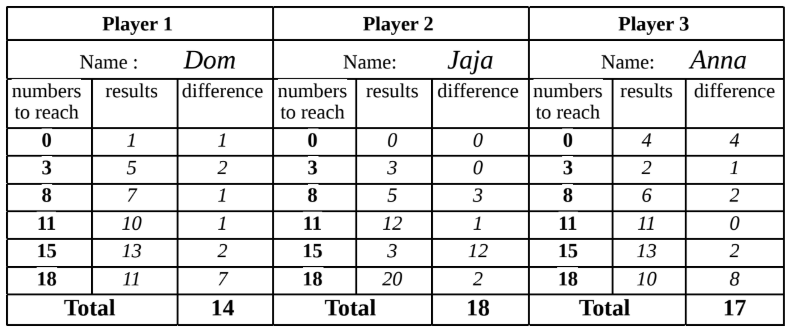
The winner is the one with the smallest total difference.
Here, Dom has won.
3. Emgann (battle)
A variant for 2 players by Julien.
The goal is to win as many cards as possible (both your own and your opponent’s) through calculations.
The jokers / variables X are set aside in this variant.
The remaining cards are shuffled well and placed in a pile. The two players sit next to each other, and each reveals 5 cards.
The first player tries, using these 10 cards, to form a chain of calculations in order to win as many cards as possible (intermediate results should also be stated!).
If the calculation is correct, the player collects the cards used and places them face up in a pile in front of them.
Then each player replenishes their row back to 5 cards, and the next player takes his turn.
The winner is the one who has “calculated” the most cards.
If a player makes a mistake, the opponent can call “kavet ’m eus” if he notices it.
If the mistake is confirmed, the cards remain on the table and the opponent plays two consecutive turns.
4. Bingo
For this variant, each player freely fills a 4×4 grid (16 squares) with numbers from 0 to 20, without repeating any number. An empty grid can be downloaded here. These numbers represent the results of arithmetic operations to be achieved during the game.
The game is played according to the basic rules of Kavet ’m eus. Event cards and variables X are removed.
The first player turns over three cards from the deck, places them face up on the table, and tries to use at least two of them to perform an operation whose result matches one of the numbers on their grid.
If successful, they circle that number and will then try during the game to form a horizontal, vertical, or diagonal line which represents a Bingo !
Unlike the basic rules, they do not play again but pass the turn to the next player. The next player replenishes the missing cards so that he again has three cards available.
If a player cannot do anything with the cards (because they do not match desired results or no operation is possible), they pass to the next player. If none of the players can use them, the first unsuccessful player may draw an additional card and try again.
Since a first bingo is quickly achieved, players may agree that the winner is the one who reaches two, three, four... up to ten possible “bingos.”
The two following variants were made by and for childrens
who cannot yet calculate but do know the numerical values from 0 to 10.
5. korrigan (goblin) – for 2 or 3 players
The variables X and event cards are removed.
A deck is prepared with 2 (for two players) or 3 (for three players) × 11 cards from 0 to 10, shuffled and placed face down in the center.
Players take turns drawing a card and placing it in front of them in order from 0 to 10, from left to right.
If a player draws a second card of the same value, they simply place it on top of the first one — the important thing is to maintain the order.
At the end, players exchange their duplicate cards to complete their sequences and allow the other players to get a complete sequence from 0 to 10.
In this game, everyone has to win!
6. Memor (Memory)
Everyone knows the Memory game, where you have to find matching pairs.
For this variant, two cards of each value from 1 to 10 are taken, shuffled, and placed out face down in even rows (4 rows of 5 cards or 5 rows of 4 cards).
Players take turns turning over two cards and stating their values.
If they match, the player keeps them and play again. Otherwise, they are turned face down again in the same place.
Then the next player takes their turn.
The winner is the one who has found the most pairs.